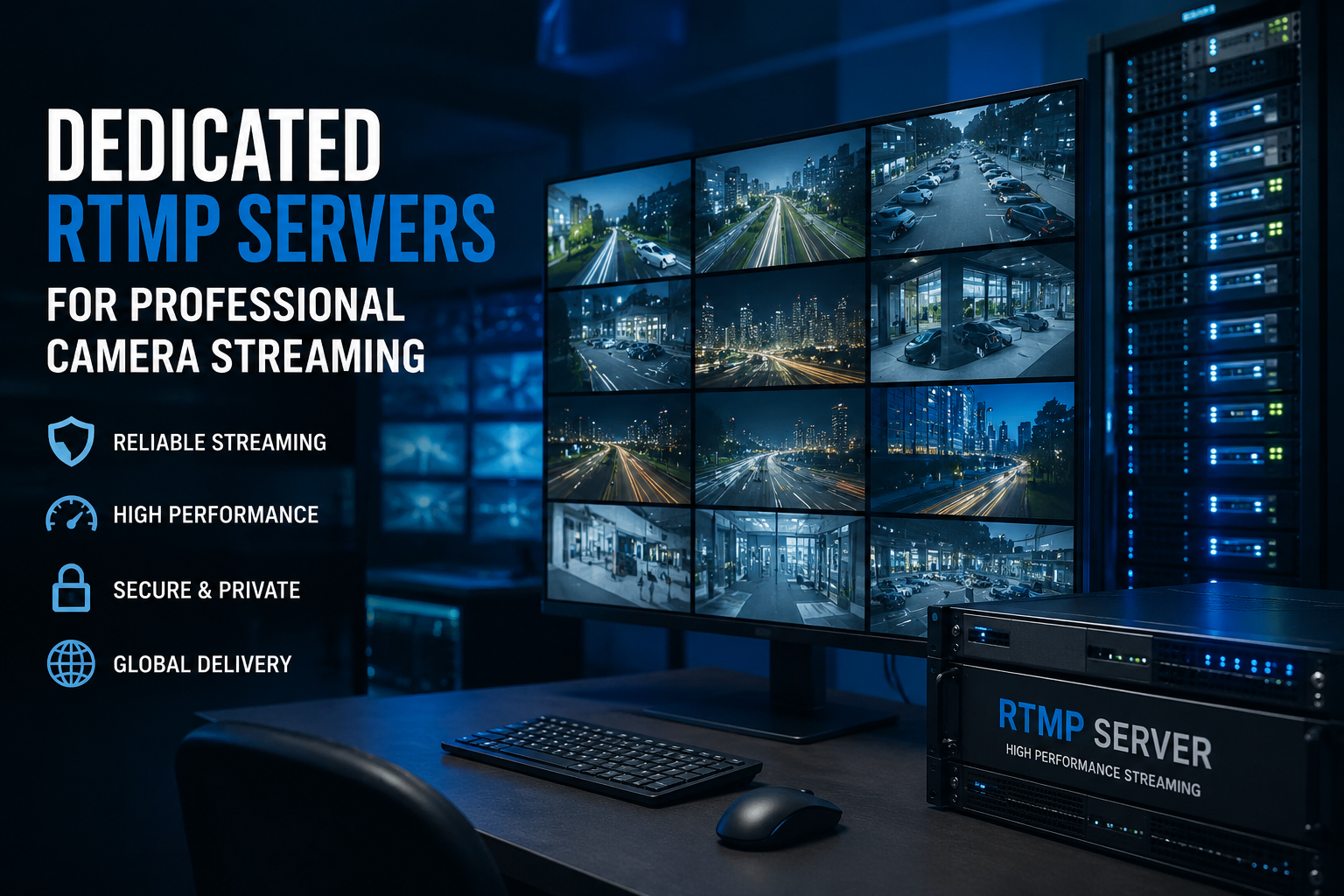
For many years, people have been predicting the death of RTMP. Yet if you look behind the scenes of thousands of successful streaming platforms, television stations, public webcams, security monitoring systems, and live event broadcasts, RTMP remains one of the most important technologies in online video delivery.
At RTMP Camera, we work with customers who need reliable ways to connect IP cameras, PTZ cameras, security systems, and live video feeds to the internet. One thing we have learned is that while cloud platforms have their place, serious streaming projects eventually reach a point where they need more performance, more flexibility, and more control.
That is where dedicated RTMP servers become extremely valuable.
Why camera streaming is different
Streaming a single webcam from your home office is relatively easy. Modern platforms such as YouTube and Facebook make it simple to go live.
The challenge comes when you need to stream continuously for days, weeks, or even months.
Consider some common scenarios:
Public city webcams
Tourism cameras
Beach and marina cameras
Traffic monitoring systems
Construction site cameras
Wildlife observation cameras
Security camera networks
Corporate monitoring systems
Religious services
Educational broadcasts
In these situations, stability becomes far more important than convenience.
A camera that goes offline every few hours is not useful. A stream that drops when traffic increases can damage your reputation and frustrate viewers.
This is why many organizations move from shared platforms to dedicated streaming infrastructure.
The advantages of a dedicated RTMP server
A dedicated RTMP server gives you an entire server reserved for your own streaming project.
Instead of sharing resources with dozens or hundreds of other users, you receive dedicated processing power, memory, storage, and bandwidth.
This creates several important advantages.
Better performance
Video streaming is resource-intensive.
Encoding, recording, transcoding, and distributing video streams require significant CPU and network resources.
A dedicated server ensures those resources are available when you need them.
Greater reliability
Many camera projects run 24 hours a day.
A dedicated server can be optimized specifically for continuous streaming workloads, reducing interruptions and improving uptime.
Full control
You can configure your server according to your project’s needs.
This includes:
Custom stream keys
Multiple channels
Recording options
Security restrictions
Access control
Custom applications
Integration with third-party platforms
Scalability
As your audience grows, a dedicated environment makes it easier to expand your infrastructure.
Many successful streaming businesses start with a single channel and later grow into networks carrying multiple live streams simultaneously.
RTMP remains the backbone of many streaming workflows
Although viewers today typically watch streams using HLS or DASH, RTMP continues to be one of the most popular ingest protocols.
Most IP camera streaming systems still rely on RTMP somewhere in the workflow.
A typical setup looks like this:
IP Camera → RTMP Server → HLS Delivery → Viewer
This approach combines the reliability of RTMP with the compatibility of modern web playback technologies.
The result is a system that works across desktops, smartphones, tablets, and smart TVs.
Learning from successful streaming providers
The streaming industry has evolved dramatically over the last decade.
Many providers that originally started with Flash streaming transitioned through Wowza, Red5, NGINX RTMP, and modern adaptive streaming technologies.
An excellent example can be found in the article “Unlock the Power of Professional Streaming with Our Dedicated RTMP Servers” published on Hosting Marketers.
The article explains how dedicated streaming infrastructure provides greater flexibility and reliability for businesses that depend on professional video delivery.
Rather than relying entirely on third-party services, organizations can maintain control over their content, audience, and streaming environment.
This approach has become increasingly important as video continues to grow as a primary communication channel.
Camera streaming projects that benefit most
Not every project requires a dedicated server.
However, certain use cases benefit tremendously from dedicated infrastructure.
Public webcams
Tourism websites often stream city centers, beaches, mountains, and landmarks.
These streams can attract thousands of viewers during peak periods.
Security monitoring
Organizations frequently need to monitor multiple locations simultaneously.
Dedicated streaming infrastructure allows centralized management of camera feeds.
Television channels
Many internet television stations use RTMP as part of their workflow for ingesting and distributing content.
Religious organizations
Churches and religious institutions increasingly depend on reliable live streaming to reach remote audiences.
Educational institutions
Schools, universities, and training centers often need continuous video delivery for online learning.
Security considerations
Security is often overlooked when discussing streaming.
However, it is particularly important when dealing with cameras.
Dedicated RTMP servers allow administrators to implement:
Password-protected streams
IP restrictions
Geographic access controls
Private viewing portals
Secure recording storage
Custom authentication systems
These capabilities help protect sensitive camera feeds from unauthorized access.
Choosing the right server
When selecting a dedicated streaming solution, bandwidth is often the most important factor.
Modern HD and 4K video streams consume significant resources.
A properly configured dedicated server should provide:
Fast processors
Sufficient RAM
SSD or NVMe storage
High network capacity
Reliable data center infrastructure
For professional deployments, many organizations prefer servers connected to high-capacity networks capable of handling large traffic spikes.
Dedicated streaming solutions
For organizations seeking a professional environment for camera streaming, live broadcasting, television channels, or large-scale video delivery, dedicated streaming servers remain one of the best long-term investments.
Solutions such as dedicated streaming servers available through RTMP Server are specifically designed for high-performance video applications, offering substantial bandwidth, powerful hardware, and infrastructure optimized for streaming workloads.
Whether you are operating a single public webcam or managing an entire network of camera feeds, dedicated infrastructure provides the stability needed for professional operation.
Final thoughts
Technology continues to evolve, but the fundamental requirements of video streaming remain the same.
Viewers expect streams to work. They expect high quality, low buffering, and reliable availability.
Dedicated RTMP servers help meet those expectations.
For organizations using IP cameras, public webcams, security systems, television channels, or live event broadcasts, a dedicated streaming environment provides the performance, reliability, and flexibility required to deliver professional results.
As camera streaming continues to grow worldwide, dedicated RTMP infrastructure remains one of the smartest foundations on which to build a successful streaming project.
